Best Way to Make a Trading Playbook (Step-by-Step Guide for 2026)
Learn the best way to make a trading playbook that builds consistency and removes emotional decisions. A step-by-step guide with the exact structure pros use.
Most traders have strategies. Very few have playbooks. The difference is the difference between a player who knows the game and a team that wins championships. A strategy is an idea. A playbook is a documented, repeatable system that removes guesswork from every trade decision you make.
If you’re grinding through losing streaks, second-guessing valid setups, or watching profitable patterns slip away because you “weren’t sure” in the moment — the problem isn’t your strategy. It’s the lack of a playbook.
This guide breaks down the best way to make a trading playbook: the exact structure professionals use, how to build it from your real trade history, the mistakes that kill most attempts, and how to use software tools to track playbook performance over time.
What Is a Trading Playbook (And Why It’s Not Just a Strategy Doc)
A trading playbook is a written catalog of your repeatable, proven setups — each documented with enough specificity that you could hand it to another trader and they’d execute it the same way you do.
The key word is repeatable. A playbook isn’t a collection of interesting chart patterns or market observations. It’s documentation of setups you have actually traded, seen work, and can define with objective criteria.
Each playbook entry contains:
- Setup name — A memorable label like “Bull Flag Breakout” or “Support Bounce at VWAP”
- Market context — The condition the setup requires (trending day, high volatility, specific session)
- Entry trigger — The exact signal that confirms the trade (break of level, candle pattern, volume surge)
- Stop-loss placement — Where you’re wrong, defined before entry, not after
- Profit targets — R-multiple targets or technical levels where you take profit
- A reference screenshot — A visual anchor of what the setup looks like at its best
Without every one of these components, you don’t have a playbook entry — you have a vague idea that will get distorted the moment price action puts you under pressure.
Why a Trading Playbook Transforms Your Performance
The single biggest reason traders bleed out slowly over months isn’t bad strategy — it’s inconsistent execution. They take good setups when confident, skip them when nervous, add size when they feel “hot,” and revenge trade after losses. None of that has anything to do with market analysis. It’s all decision-making under pressure without a reference document.
A playbook solves this by turning trade decisions into a lookup operation. When a setup starts forming, you ask: “Is this in my playbook?” If yes, you execute it exactly as documented. If no, you pass. Full stop.
This produces three compounding improvements:
Consistency — You take every valid setup, not just the ones you feel confident about. Consistency is what turns a 55% win-rate setup into actual profitability over a large sample.
Measurability — Once setups are named and documented, you can track performance by setup. You’ll discover that two of your five setups account for 80% of your profits, and one setup has been quietly losing you money for months.
Emotion removal — You can’t argue with a documented rule while you’re in a trade. The decision was already made when you wrote it down. That pre-commitment eliminates the internal negotiation that leads to bad exits and oversized losses.
How to Build Your Trading Playbook Step-by-Step
Building a playbook from scratch is intimidating until you realize you’re not inventing strategies — you’re documenting what you already do.
Step 1: Mine your trade history for patterns
Go back through your last 3–6 months of trades and look for setups you took repeatedly. Don’t analyze P&L yet — just identify recurring patterns in your entries. You’re looking for trades that share a setup name if you had to label them.
Step 2: Start with your one best setup
Pick the single setup you’ve traded most consistently and that you understand best. Write it up fully before adding anything else. Quality over quantity — one complete, tested entry is worth more than five half-written ones.
Step 3: Write the entry criteria with brutal specificity
“Stock moving up with volume” is not a criterion. “Price breaks above prior day’s high on 2x average volume with RSI above 55 on the 5-minute chart” is a criterion. The test: could you give this to a programmer and have it coded into a backtest? If not, tighten it up.
Step 4: Add a screenshot of the setup in its ideal form
Find the cleanest, most textbook example of this setup from your trade history and attach it to the entry. This visual anchor is what your eye trains to find. One strong reference image beats a paragraph of text.
Step 5: Define invalidation and stop placement
Where are you wrong? Write it as a rule, not a judgment call. “Stop goes 10 cents below the breakout level” or “Stop at the prior candle’s low.” If you can’t define it before entry, you’ll define it emotionally during the trade.
Step 6: Backtest before promoting to your active playbook
Before you trade a documented setup with full size, review at least 20–30 historical examples. Count the win rate. Measure the average R-multiple. Look for the conditions where it fails. This step separates a hypothesis from a validated setup.
Step 7: Tag every live trade to a playbook entry
From here forward, every trade you take gets labeled with a setup name. This connects your real-money performance to specific setups and starts building the data you need to know what’s working.
Common Mistakes Traders Make When Building a Playbook
Adding too many setups too fast — The goal of a playbook isn’t comprehensiveness. Traders who document 20 setups in their first week end up with 20 half-understood patterns that create more indecision, not less. Build depth before breadth.
Using vague language — Words like “strong momentum,” “clean setup,” or “obvious level” are subjective. They feel precise in the moment but mean something different every time the market is moving. Rewrite every criterion using objective, measurable terms.
Skipping the screenshot — Many traders write the criteria but skip the visual. This is a mistake. Trading is a visual skill. The reference screenshot is what trains pattern recognition faster than text ever will. Use the best example you have, not just any example.
Never reviewing playbook performance — A playbook that doesn’t get reviewed is just a document. Schedule a weekly review: which setups did you take, which did you skip, and what did the outcome data say? The playbook should evolve based on evidence, not instinct.
Including setups you’ve never actually traded — It’s tempting to add patterns from trading books or YouTube videos that look good in theory. Don’t. Your playbook should only contain setups you’ve personally executed and observed. Secondhand setups haven’t been filtered through your own psychology and execution style.
How TradingEdge Journal Helps You Build and Track Your Playbook
TradingEdge Journal has a dedicated Playbook feature built specifically around this workflow.
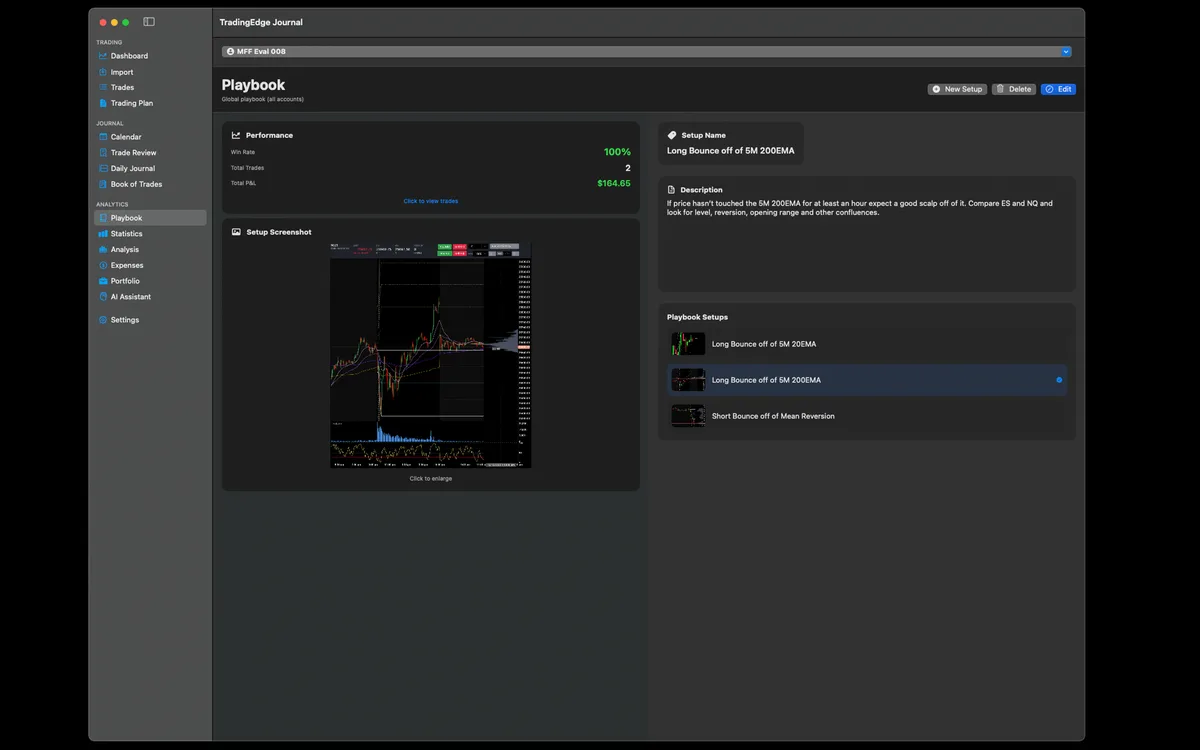
Inside the app, you create a Playbook entry for each setup — giving it a name, writing a description of the criteria, and attaching a screenshot directly from your trade history or saved charts. The setup lives in a visual library you can reference at any time.
When you log trades in TradingEdge, you tag each one with a setup name from your playbook. The app then automatically tracks performance by setup — showing you the win rate, total trade count, and total P&L for every entry in your playbook. You can click into any setup and see the full list of trades that used it.
This closes the feedback loop that most traders never complete. You don’t have to manually calculate which setups are working — the journal does it continuously in the background. Over weeks and months, the data tells you clearly: which setups to trade bigger, which to paper trade more before sizing up, and which to cut entirely.
The Playbook also integrates with TradingEdge’s AI analysis. The AI reads your documented setups alongside your actual trade data and identifies patterns like “you follow this setup’s exit rules 90% of the time but deviate on this one specific condition” — the kind of edge-level insight that takes most traders years to surface manually.
FAQ / Bottom Line
The bottom line: The best way to make a trading playbook is to start with one setup, document it with complete specificity, add a reference screenshot, validate it on historical trades, and then tag every live trade to a playbook entry from that point forward. The playbook grows from evidence — not theory.
Traders who operate without a playbook are always starting over. Every losing stretch sends them back to strategy shopping. Traders with a documented, performance-tracked playbook can see exactly where the edge is breaking down and fix the specific thing that’s wrong.
Start with one setup. Write it down completely. Trade it consistently. Let the data tell you what to keep.