Best Trading Journal App: Tradervue vs TraderSync (2026)
The best trading journal app is Tradervue or TraderSync for most traders. Here's an honest comparison of features, pricing, and which fits your style.
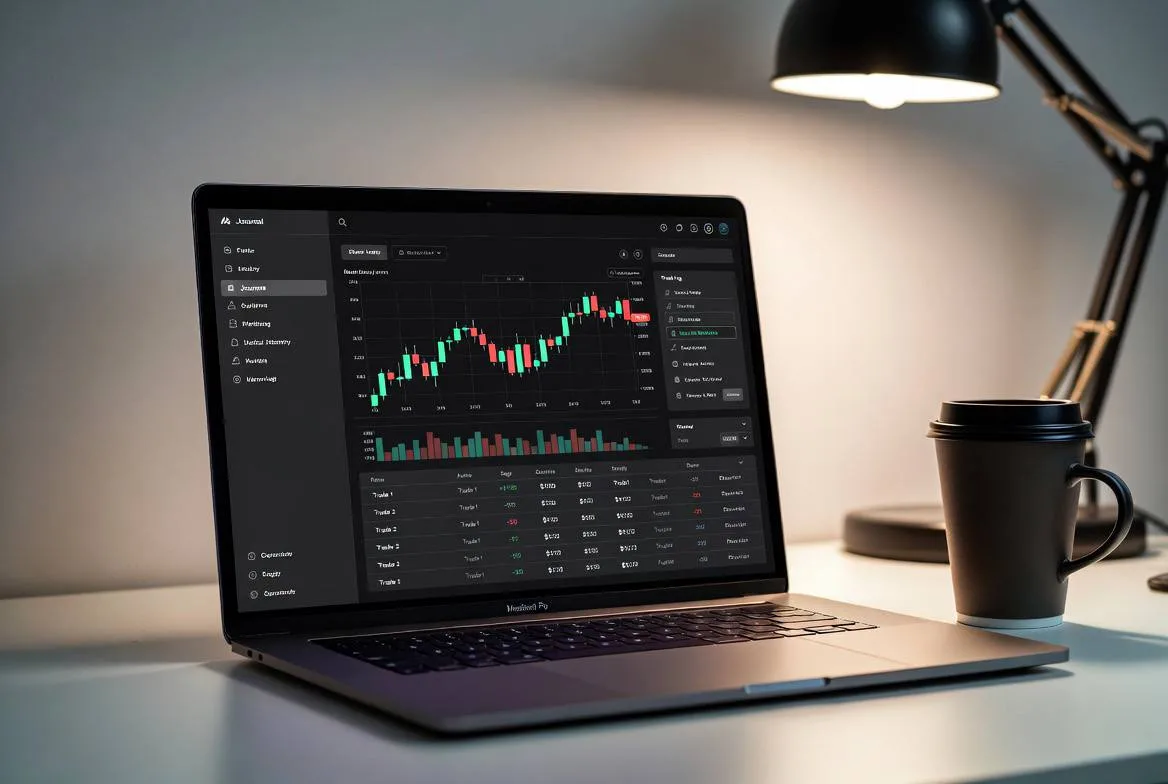
The brutal truth: 90% of traders lose money. But here’s the interesting part—most of them have no idea why. They execute trades, close positions, and move on to the next setup without ever analyzing what actually happened. It’s like flying blind.
That’s where a trading journal app comes in. The difference between a trader who improves year-over-year and one who repeats the same mistakes is simple: documentation and review. A solid trading journal transforms scattered trades into a searchable database of your decision-making patterns, revealing which setups work, which timeframes suit your style, and where your psychological weak points show up most often. If you’re new to journaling entirely, start with our complete guide to trading journals before diving into app comparisons.
In this guide, we’re cutting through the noise. We’ll break down the best trading journal apps on the market—Tradervue, TraderSync, WingmanTracker, and others—so you can stop comparing spreadsheets and start building a real edge. Whether you’re a day trader managing 500+ trades annually, an options specialist tracking complex multi-leg positions, or a swing trader working a day job, we’ve got a recommendation that fits your workflow and budget.
What Is a Trading Journal App? (And Why Not Just Use Excel?)
A trading journal app is a purpose-built platform where you log trades, track key metrics, and analyze your performance over time. Unlike a spreadsheet, it automatically syncs with your broker, generates dozens of reports on command, and tags your trades by strategy, market condition, and emotion.
Here’s the distinction: spreadsheets are static. You manually enter data (error-prone), you manually calculate win rates, and you manually spot patterns. Trading journal apps are dynamic—they pull trades directly from your broker, auto-calculate your Sharpe ratio, drawdown, and risk-adjusted returns, and use AI to flag which setups are actually profitable.
Top platforms like Tradervue support 80+ broker integrations (think: Interactive Brokers, TD Ameritrade, Alpaca, Coinbase, and many others), meaning your trade data flows in without manual entry. Others like TraderSync add AI-powered analysis—their “Cypher” assistant scans your trades and tells you exactly which patterns are winning money.
Why It Matters for Your Trading Performance
Let’s be direct: a trading journal is the difference between amateur and professional trading.
Win rate is a vanity metric. You might be winning 60% of your trades but losing money because your losers are 3x larger than your winners. A journal reveals this immediately. When you see that your “biggest winners” only come from one specific market condition (say, first hour of market open on trend days), you can stop wasting time on afternoon ranges.
Psychological patterns hide in plain sight. You probably know you over-trade when frustrated or take less risk after a losing streak. A journal proves it. Tag your trades by emotion—frustrated, confident, neutral—and run a report. You’ll see the statistical damage clearly: “Frustrated trades have a 32% win rate vs. my 55% baseline.” That’s actionable. That’s worth thousands of dollars. For a deeper look at the specific metrics you should be tracking, see our guide to trading performance metrics every day trader should track.
Broker sync saves hours and eliminates errors. Manually entering commissions, slippage, and fees is tedious and you’ll get them wrong. Tradervue auto-imports from your broker, calculating your true net P&L after costs. One missed commission entry per day = $250/month in invisible leakage you’ll never notice in a spreadsheet.
Backtesting and forward testing become measurable. If you journal consistently, you can compare: “How did my morning breakout strategy perform over 60 trades in February vs. 60 trades in a backtest?” You spot overfitting immediately, saving yourself from blowing up on a strategy that only worked in hindsight.
The bottom line: traders who journal improve. Studies across professional trading firms show that active journalers increase their win rate by 20-30% within 90 days simply because they stop repeating mistakes. If you’re trading $10,000 per position, a 3% improvement in win rate = $300 more per 100 trades. That’s $3,000 per 1,000 trades. Your journal costs $30-80/month. The math is obvious.
How to Apply It: Step-by-Step Setup & Best Practices
Setting up a trading journal app isn’t complicated, but doing it right determines whether you actually use it or it becomes another abandoned subscription.
Step 1: Choose Your Platform Based on Asset Class
- Stocks/futures traders → Tradervue (100+ reports, most brokers supported)
- Crypto/options traders or AI enthusiasts → TraderSync (Cypher AI, market replay simulator)
- Complex multi-leg options → WingmanTracker (automated position tracking)
Step 2: Connect Your Broker Most apps take 5 minutes. Log in, authorize the API connection (secure, read-only access), and your trades begin importing automatically. Tradervue supports:
- Interactive Brokers
- TD Ameritrade / Schwab
- Alpaca
- Coinbase (crypto)
- Futures brokers (NinjaTrader, CQG, and others)
Step 3: Create a Tagging System This is critical. Tags are how you slice and dice your performance. Create categories for:
- Strategy (momentum breakout, mean reversion, earnings play, etc.)
- Timeframe (5-min scalp, 1-hour swing, 4-hour position)
- Market condition (strong uptrend, choppy range, news event)
- Emotion during trade (confident, FOMO, frustrated, neutral)
- Bias errors (over-traded, under-traded, held too long)
When you tag consistently, you unlock reports like: “My mean reversion trades in uptrends have a 28% win rate, but my mean reversion trades in downtrends have a 64% win rate.” Boom—now you know what actually works.
Step 4: Set Up Your Key Reports Don’t get lost in the 100+ available reports. Start with these:
- Win rate by strategy (which setups make money?)
- Win rate by timeframe (are you better at scalping or swinging?)
- Average winner vs. average loser (is your risk-reward positive?)
- Drawdown analysis (how much pain do you endure?)
- Trade duration by outcome (do your winners take longer to develop than losers?)
Step 5: Weekly Review Ritual Block 30 minutes every Sunday or Friday evening. Load your platform, run your reports, ask yourself:
- What was my best trade this week? What made it work?
- What was my worst trade? Where did I break my rules?
- Which tag group has the worst win rate? Why?
- Did emotion influence my performance?
This ritual compounds. After 12 weeks, you’ll see patterns clearly. After 6 months, you’ll have eliminated half your mistakes. After a year, you’ll trade like someone who actually knows what they’re doing.
Common Mistakes Traders Make with Journaling
You’ve probably seen this: a trader signs up for Tradervue, logs 50 trades, then abandons the platform. Six months later, they’re wondering why they’re not improving.
Mistake #1: No Tagging System Traders log trades but don’t tag them. Result: 500 trades in the system, zero insights. You can’t run meaningful reports on untagged trades. Spend 30 seconds tagging each trade—it pays for itself in your first analysis.
Mistake #2: Journaling Only Winning Trades Psychological bias is real. You remember your winners vividly but conveniently forget the losers. A real journal captures everything. That losing streak? It’s the most valuable data you have. Your journal should reflect all 500 trades, not just the 300 you’re proud of.
Mistake #3: No Written Trade Plan Some traders log the trade after closing it. That’s backward. Before you enter, write down: “Setup: breakout above resistance. Target: $X. Stop: $Y. Why I’m taking it: price action + volume confirmation.” Then review against actual outcome. This trains discipline and removes hindsight bias.
Mistake #4: Comparing Win Rate Without Context You see “55% win rate” and think that’s good. But if your average winner is $100 and average loser is $200, you’re losing money. A journal reveals the full picture: risk-reward, drawdown, Sharpe ratio. A 50% win rate with 2:1 risk-reward beats a 65% win rate with 0.8:1 risk-reward every single time.
Mistake #5: Not Reviewing Consistently A journal only works if you actually look at it. Set a recurring calendar reminder. Block Friday evening or Sunday morning. If you skip reviews for 3 weeks, you lose momentum and insights evaporate. For a detailed framework on building a review ritual that sticks, read how to use a trading journal to actually improve your performance.
How TradingEdge Journal Helps Solve These Problems
This is where a purpose-built tool makes the difference. Let’s say you’re torn between Tradervue and TraderSync. Both are excellent, but they solve different problems:
Tradervue is the industry standard—200,000+ active traders use it. Why? It’s battle-tested, stable, and comprehensive. The platform excels at:
- Seamless broker sync across 80+ brokers with zero friction
- Depth of analysis with 100+ reports covering every angle of performance
- Proven track record in the community (if your trading buddy uses it, your data format is compatible)
- Clear pricing tiers: free (100 trades/month), $29.95/month (unlimited trades), $49/month (premium analytics)
Best for: Stocks and futures traders who want reliability and don’t mind a steeper learning curve to unlock advanced reports.
TraderSync is the innovator. It’s newer, faster, and AI-powered. Its key advantages:
- Cypher AI assistant that scans your trades and identifies winning patterns automatically (Tradervue doesn’t offer this)
- Market replay simulator (unique feature) allowing you to practice strategies on historical data without live capital
- Mobile apps (iOS/Android) so you can review trades on the go
- Cleaner interface with a focus on beautiful dashboards over overwhelming reports
- Pricing: free plan (more generous), $29/month (standard), $79.95/month (pro with AI)
Best for: Crypto traders, options traders, and traders who want AI-powered insights and are willing to pay for innovation.
For complex options strategies, consider WingmanTracker as a specialized complement:
- Automated multi-leg position tracking (your strangles and iron condors are tracked as single positions)
- Automatic roll management (when you roll a position, it’s recorded as one logical trade, not three separate entries)
- Cost basis automation (no manual calculation of realized/unrealized P&L on complex spreads)
Tradervue vs TraderSync: Head-to-Head Comparison
Here’s a practical breakdown to help you decide:
| Feature | Tradervue | TraderSync |
|---|---|---|
| Broker Integrations | 80+ (most comprehensive) | 50+ (solid but fewer) |
| AI-Powered Analysis | No | Yes (Cypher) |
| Market Replay Simulator | No | Yes |
| Mobile App | Limited | iOS/Android (full featured) |
| Reports Available | 100+ | 30-40 (curated, easier to use) |
| Learning Curve | Steep (feature-rich) | Moderate (intuitive) |
| Free Trial | 100 trades/month | More generous free plan |
| Pricing (Entry) | $0-29.95/month | $0-29/month |
| Pricing (Premium) | $49/month | $79.95/month |
| Community Size | Large (200,000+ users) | Smaller (growing) |
| Best For | Stocks/futures purists | Crypto, options, AI seekers |
Cost-per-trade analysis: If you trade 100 times per month:
- Tradervue: $0.30 per trade (at $29.95/month)
- TraderSync: $0.29 per trade (at $29/month)
They’re virtually identical on price. The decision comes down to features and comfort level.
Choose Tradervue if you:
- Trade stocks or futures exclusively
- Want maximum broker compatibility
- Don’t mind a complex interface for powerful reports
- Value platform maturity and stability
Choose TraderSync if you:
- Trade crypto or options
- Want AI to identify your winning patterns automatically
- Like clean, mobile-first design
- Want to backtest in a simulator before live trading
FAQ & Bottom Line
Q1: Is a free trading journal app good enough?
Partial answer: free tiers (Tradervue’s 100 trades/month, TraderSync’s free tier) are great for testing. But if you trade actively, you’ll hit the ceiling. A free tier becomes frustrating when it caps your data. For $30/month, you get unlimited trades and professional-grade analysis. It’s worth it.
Q2: How long until a journal actually helps my trading?
Realistically: 4-6 weeks of consistent data entry and weekly reviews before patterns emerge. After 12 weeks, you’ll have statistical confidence (“My morning breakouts win 62% of the time”). After 6 months, you’ll see seasonality and psychological patterns clearly.
Q3: Which app integrates best with crypto exchanges?
TraderSync edges out Tradervue here. It natively supports Coinbase, Kraken, and Binance. Tradervue supports them but with slightly more manual work in some cases. If you’re a crypto trader, TraderSync is the safer choice.
Q4: Can I use a trading journal for backtesting?
Not directly. Tradervue and TraderSync are for logging live trades. But TraderSync’s market replay simulator lets you practice a strategy on historical data before risking capital. Tradervue focuses purely on analyzing trades you’ve already taken.
Q5: What if my broker isn’t supported?
You have options: (1) manual CSV import (tedious but possible), (2) switch to a supported broker (many do sync), or (3) use a broker-agnostic tool like StockJournal (which prioritizes ease of use over automation). The goal is journaling—the method is secondary.
Bottom Line
A trading journal app isn’t optional—it’s foundational. The difference between a trader who loses money and a trader who builds consistent edge comes down to one thing: data review and system refinement. Without journaling, you’re guessing. With journaling, you’re learning.
For most traders: Start with a free trial of Tradervue (if you trade stocks/futures) or TraderSync (if you trade crypto/options or want AI analysis). Spend two weeks logging your trades and running basic reports. You’ll quickly feel which platform fits your brain.
For options traders specifically: Add WingmanTracker to your toolkit. It solves the multi-leg tracking problem that other platforms fumble.
The real competitive advantage isn’t the app—it’s the discipline. Sign up, set your tags, commit to a weekly review ritual, and watch your trading improve. Most traders skip this step. You won’t. That’s your edge.